
Understanding the ocean as one connected system
Dawn Murray's career in marine science has taken her from jellyfish research and intertidal ecology to documenting Indigenous knowledge in Bhutan and a seat on the advisory council of the first Indigenous-led National Marine Sanctuary in the United States. In this conversation, she explains how those experiences connect, and what thirty-five years of following the science teaches you about how the ocean works, why it matters, and what it takes to protect it.
Watch the episode below, watch it on YouTube for clickable chapters/timestamps - or scroll down for a full summary and additional resources.



Episode summary
Marine biologist Dawn Murray grew up between the California coast and Hawai'i, surrounded by the ocean from an early age. That connection stayed with her and eventually shaped the direction of her entire career. Although she began studying art history and Italian in college, she found herself repeatedly drawn to biology and oceanography, eventually switching her focus to marine science.
Her research took her from jellyfish to intertidal ecology, where she looked at how human-built shoreline structures affect which species can settle and survive. It's a small-scale example of something Dawn returns to throughout the conversation: the ocean works as one connected system, and what happens at the microscopic level, in currents, nutrient cycles, and plankton, has consequences for climate and food webs everywhere, not just along the coastline.
Manta rays come up as a concrete example of how those connections play out. Because they feed low on the food chain, their presence is a good sign that the nutrient cycles beneath them are working. Dawn and Martina also get into the basics: what plankton actually is, why dive lights attract it at night, and why the science behind a manta encounter goes much further than most guests expect.
The second half of the conversation moves from research into teaching and advocacy. Dawn guides graduate students across the globe through programmes that mix environmental science, Indigenous knowledge, and hands-on fieldwork. Through the Tribal Trust Foundation, she has worked with Indigenous communities in Tulum and Ecuador, spent six months in Bhutan documenting medicinal plant knowledge with the Monpa community, and supported the eight-year campaign that led to the Chumash Heritage National Marine Sanctuary being designated in November 2024 as the first Indigenous-led national marine sanctuary in the United States.
Dawn also talks about Miloli'i, a small fishing community south of Kona that has built its own conservation and monitoring programme from the ground up, and where she brought the students that first connected her to Martina. The conversation closes with both of them talking through what meaningful ocean protection actually looks like in practice and why it takes many different kinds of people, working from many different places, to make it happen.
Takeaways:
The ocean operates as one connected system, and understanding currents, nutrient cycles, and plankton changes how you see climate and food systems.
Individual species can often tell us more about ecosystem health than any single data point or snapshot measurement.
Environmental education works best when it moves beyond theory into hands-on work rooted in real communities.
Indigenous communities have sustainably managed ecosystems for generations, and that accumulated knowledge often runs deeper than formal science has documented.
Meaningful conservation is slow, collaborative work that depends on policy, local leadership, and people contributing what and where they can.
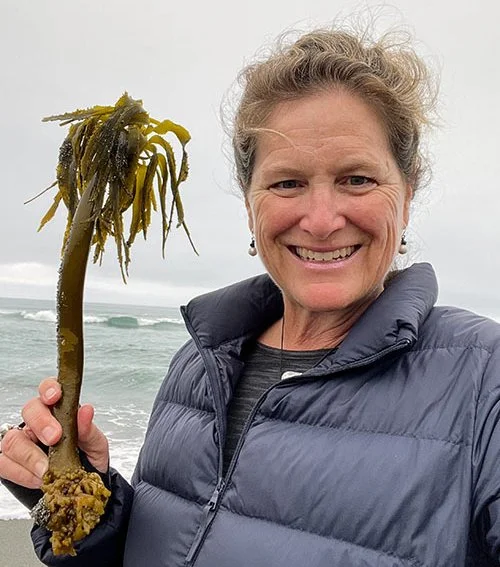
Today’s guest: Dawn Murray
Dawn Murray is a marine biologist, professor, and environmental advocate based in Santa Barbara, California.
Her career has taken her from the Monterey Bay Aquarium to deep-sea research, intertidal ecology, and the co-creation of LiMPETS, a community science monitoring programme she built with NOAA that is still running today. She teaches environmental and marine science at university level and leads trips that get people out into nature around the world.
Beyond the lab and classroom, Dawn serves as an advisor to the Northern Chumash Tribal Council and spent eight years supporting the campaign that led to the designation of the Chumash Heritage National Marine Sanctuary in November 2024, the first tribally nominated sanctuary in the United States. She is currently co-creating a curriculum that weaves Chumash Indigenous ecological knowledge together with Western science methods.
Manta rays have always held a special place in her work, which is what brought her to Martina and the waters off the Big Island in the first place.
- Connect with Dawn on LinkedIn, Instagram, or Facebook
- Find out more about Dawn's academic work at the University of California, Santa Barbara, and Antioch University, New England.
Resources from this episode:
Monterey Bay Aquarium — The aquarium where Dawn worked early in her career and first deepened her interest in jellyfish and marine education
Moon Jelly (Aurelia aurita) — The species Dawn studied during her early research
Monterey Bay Aquarium Research Institute (MBARI) — The research institute where Dawn worked alongside oceanographers studying marine snow and deep-sea systems
Mary Wilcox Silver — Oceanographer and mentor to Dawn; co-pioneer in marine snow research
Alice Alldredge — Oceanographer and co-researcher in marine snow studies
John Pearse (In Memoriam) — Marine biologist who mentored Dawn during her PhD work on intertidal ecology
California Sea Grant — Program supporting coastal research and education, connected to Dawn’s early citizen science work
LiMPETS (Long-term Monitoring Program and Experiential Training for Students) — Community science program monitoring California’s coastal ecosystems
NOAA (National Oceanic and Atmospheric Administration) — Federal agency overseeing ocean research and national marine sanctuaries
National Marine Sanctuaries — NOAA’s sanctuary system, including the Chumash Heritage National Marine Sanctuary
Chumash Heritage National Marine Sanctuary — The first Indigenous-led national marine sanctuary in the United States
Chumash Tomol Crossing — Traditional plank canoe crossing to the Channel Islands
Atlantic Manta Ray (Mobula yarae) — The third described manta species discussed in the episode
Dr. Andrea Marshall — Marine megafauna researcher involved in identifying the third manta species
Tribal Trust Foundation — Organization supporting Indigenous-led conservation efforts
5 Gyres Institute — Organization focused on global plastic pollution advocacy
Royal Thimphu College, Bhutan — University where Dawn taught while working with the Monpa community
Monpa Medicinal Plants: Indigenous Knowledge from a Himalayan Healer (PDF download) — The book documenting traditional Monpa medicinal knowledge, developed in collaboration with community elders
Miloliʻi ʻŌpelu Project — Community-led marine management initiative in Hawai‘i
The Malolo Project — Restoration of a historic Hawaiian koa racing canoe connected to the Miloliʻi fishing community
Marine Snow — Explanation of how organic material sinks from surface waters to the deep ocean
Microscopic Plankton (Diatoms, Dinoflagellates, Foraminifera, Radiolarians) — Images and explanation of key plankton groups discussed in the episode
Take action
Understanding how ocean systems work is the first step toward protecting them. Explore the organisations and communities mentioned in this episode, stay curious about the science, and look for ways to support ocean stewardship in your own community, whether through advocacy, education, or everyday choices.